Industrial Facility Cleaning: What Makes It Different from Standard Commercial Cleaning
A cleaning company arrives at a production facility. They have cleaned offices and retail spaces for years. They are thorough, reliable, and do good work. But no one told them about the epoxy coating on the floor, the chemical storage area near the loading dock, or the fact that production does not stop for a two-hour cleaning window.
This is not a hypothetical. It is what happens when standard commercial cleaning and industrial facility cleaning get treated as the same thing.
They are not. Industrial facility cleaning requires different training, different products, different scheduling, and a different understanding of what clean actually means. This guide covers what sets it apart, what it includes, and how to tell whether your facility needs a specialist.
Not Just a Heavier Clean
The difference between commercial and industrial cleaning is not a matter of degree. It is a matter of kind.
A commercial cleaner knows how to clean an office bathroom, strip a vinyl floor, and sanitize a kitchen. That knowledge is real and it matters. But it does not transfer automatically to an industrial environment. Industrial facilities contain substances, surfaces, and equipment that require specific training to clean safely and correctly.
Use the wrong solvent on a coated concrete floor and you may strip the finish, create a slip hazard, and void a warranty. Vacuum the wrong way in a woodworking or metal fabrication environment and you may redistribute combustible dust rather than remove it. Start cleaning near a piece of equipment that has not been properly locked out and you have a workplace safety issue.
These are not edge cases. They are the baseline considerations that industrial cleaning experience provides. A company without that experience is not a smaller version of an industrial cleaner. They are a different thing entirely.
What Industrial Facility Cleaning Actually Covers
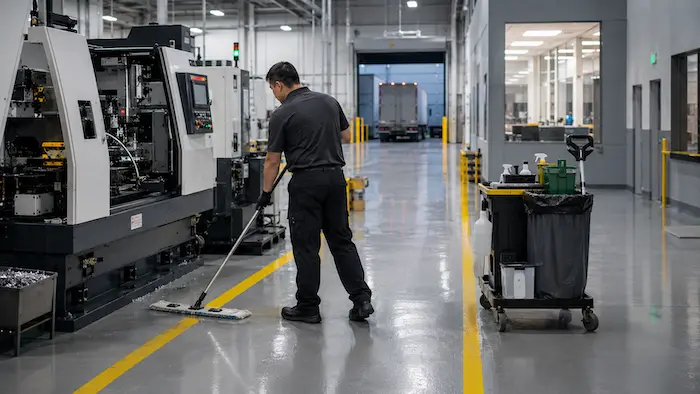
The scope of industrial facility cleaning varies significantly by facility type, but the core areas are consistent across most industrial environments.
- Production floors and machinery surrounds, including grease, oil, metal shavings, and process residue
- Industrial floor maintenance: epoxy-coated concrete, sealed concrete, rubber anti-fatigue mats, steel grating, and chemical-resistant surfaces
- Washrooms serving shift workers, which see higher traffic volume and different soil types than standard commercial washrooms
- Lunchrooms, cafeterias, and break areas within industrial facilities
- Chemical storage areas, with appropriate product selection and handling protocols
- Loading docks and warehouse areas
- Offices, reception areas, and administrative spaces within an otherwise industrial building
The Canadian Centre for Occupational Health and Safety (CCOHS) provides guidelines on workplace safety in industrial environments, including chemical handling and hazard identification. These standards are the baseline for any cleaning company working in an industrial facility.
Every programme is built around the specific facility. A food processing plant has requirements that a machine shop does not. A pharmaceutical manufacturer has a clean standard that a fabrication shop never needs to meet. The scope of industrial cleaning is not one-size-fits-all, and a company that treats it that way does not understand the work.
The Four Things That Make It Different
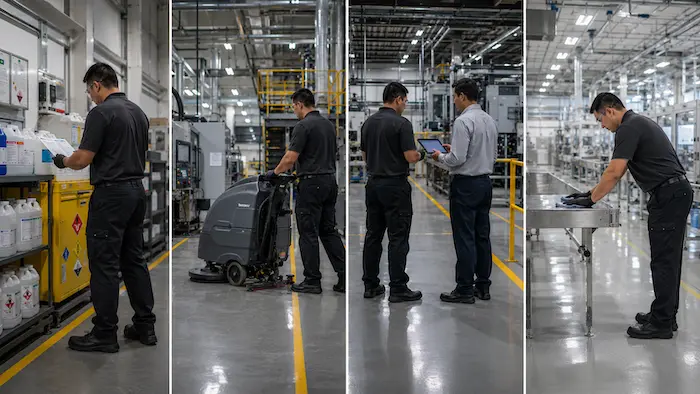
Industrial facility cleaning differs from standard commercial cleaning in four specific ways: hazard awareness and WHMIS compliance, surface and equipment compatibility, scheduling around production, and the clean standard itself. Each one represents a capability gap between a general commercial cleaner and a company with real industrial experience.
1. Hazard Awareness and WHMIS Compliance
Any company cleaning in an industrial environment needs staff trained to WHMIS 2015. Not general chemical awareness. WHMIS.
WHMIS 2015 governs hazardous product labelling, safety data sheets, and worker education in Canadian workplaces. In an industrial facility, the cleaning team is working around substances that carry specific handling, storage, and disposal requirements. Without WHMIS training, staff do not know what those requirements are, and they cannot read the safety data sheets that tell them.
In certain facilities, combustible dust is an active safety concern. Woodworking, metal fabrication, food processing, and chemical manufacturing all produce particulates that can ignite or explode under the right conditions. The wrong vacuuming equipment or the wrong cleaning sequence can redistribute rather than remove combustible dust. This is not a theoretical risk. The CCOHS publishes specific guidance on combustible dust safety, and it applies directly to cleaning operations in these environments.
A cleaning company that cannot confirm WHMIS 2015 training for their staff should not be working in your facility. It is not a preference. It is a compliance requirement. CCOHS guidance on workplace hazardous materials provides the full regulatory context.
2. Surface and Equipment Compatibility
Industrial floors are not uniform, and the differences matter.
Epoxy-coated concrete requires a specific pH range in cleaning products. Sealed concrete has different tolerances. Rubber anti-fatigue mats used in assembly and fabrication environments need to be cleaned without products that degrade the rubber compound. Steel grating requires different equipment entirely. Using a standard commercial floor scrubber and cleaning solution across all of these surfaces is the kind of mistake that causes real damage.
The same principle applies to cleaning around equipment. Machinery that has been recently operated may have residual heat, lubricant spray, or process residue that changes what cleaning approach is appropriate. A cleaning team that does not understand machinery environments does not know to check these things before they start.
Surface and equipment compatibility is not something a commercial cleaner can figure out on the job. It requires prior experience or proper industrial training before the first visit.
3. Scheduling Around Production
Commercial cleaning schedules around people. Industrial cleaning schedules around machines and production cycles.
Production facilities have planned downtime windows, shift handovers, and machine cool-down periods that determine when cleaning can happen and in which areas. In environments where lock-out/tag-out (LOTO) protocols apply, cleaning around certain equipment requires formal coordination with the production team. LOTO is a workplace safety procedure that ensures machinery is properly shut down and de-energized before anyone works near it. It applies to cleaning staff as much as it applies to maintenance personnel.
The Canada Occupational Health and Safety Regulations establish the legal framework for confined space entry and LOTO procedures. A cleaning company working in a facility where these apply needs to understand and comply with them, not work around them.
A cleaning company that cannot integrate with a production schedule is not a fit for an industrial environment. The question to ask any prospective provider is not just when they clean, but how they coordinate with your operations team before they start.
4. The Clean Standard Itself
In a commercial office, clean means presentable. In an industrial facility, clean may mean something else entirely, depending on the sector.
In a food processing facility, clean means auditable. The Canadian Food Inspection Agency (CFIA) and HACCP standards require documented cleaning frequencies, approved cleaning agents, and records that demonstrate compliance. A cleaning company working in a food facility needs to understand these requirements and clean with regards to them, not to a general commercial standard.
In a pharmaceutical or medical device manufacturing environment, clean means validated. GMP (Good Manufacturing Practice) standards require that cleaning processes be documented, qualified, and traceable. A cleaning company that has never worked to GMP standards cannot simply adopt them without training and process development.
Even in facilities that do not have regulatory compliance requirements, the standard for industrial clean is typically higher than commercial clean because the stakes are different. Health Canada’s guidance on sanitation in food processing outlines what food-grade cleanliness requires. The underlying principle applies across industrial contexts: the clean standard is set by the facility’s risk profile, not by a generic cleaning programme.
Which Facilities Actually Need Industrial Cleaning?
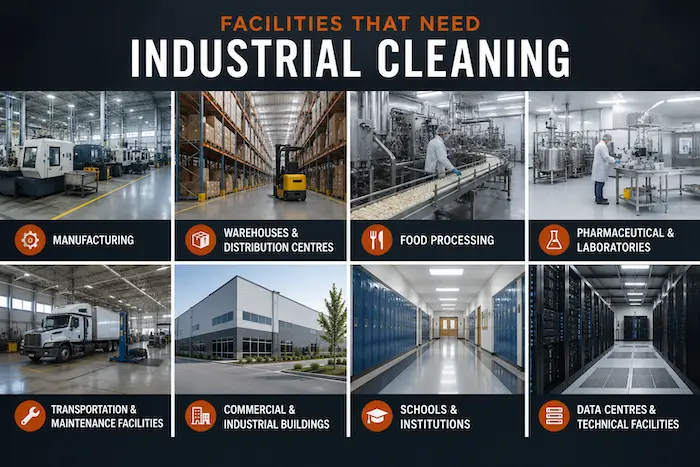
The line between commercial and industrial is not always obvious. A facility that looks like a commercial building from the outside may have industrial cleaning requirements inside. The question to ask is not what your building looks like, but what hazards are present and what standard does cleaning need to meet.
If your facility involves any of the following, you are in industrial cleaning territory:
- Manufacturing and machine shops: metal shavings, cutting fluids, lubricants, and production residue across large floor areas
- Food processing and commercial kitchens at scale: CFIA compliance, HACCP requirements, allergen cleaning protocols
- Warehouses with chemical storage: WHMIS obligations, spill containment areas, loading dock soil management
- Auto parts and vehicle assembly: oils, greases, process chemicals, and high-traffic production floors
- Pharmaceutical and medical device manufacturing: GMP cleanliness requirements, validated cleaning processes
- Printing, woodworking, and metalworking: combustible dust environments, solvent handling, ink and coating residue
If your facility does not fit neatly into any of these categories but you have shift workers, heavy machinery, or chemical storage on site, it is worth having a conversation with a cleaning company that has industrial experience before assuming standard commercial cleaning will cover it.
For a broader look at evaluating any cleaning company before you hire, our guide on how to choose a commercial cleaning company covers the key questions to ask, with industrial-specific additions worth raising with any prospective provider.
Industrial Facility Cleaning in Kitchener-Waterloo
Kitchener-Waterloo has one of the strongest manufacturing and industrial bases in Ontario. Advanced manufacturing, food processing, auto parts, and fabrication are all part of the regional economy. Sunset Quality Cleaning has been working in this market since 1986.
Our staff are WHMIS trained, bonded, insured, and experienced with multi-zone and multi-hazard facility environments. We build a custom cleaning programme around each facility’s production schedule, compliance requirements, and surface types. Not a standard package applied across different buildings. A programme built for you.
- 35+ years serving commercial and industrial facilities in the KW region
- 50+ trained, long-tenured staff
- Bonded, insured, WSIB covered, $5M general liability
- WHMIS 2015 trained staff
- Eco-friendly cleaning products as standard
- Custom programmes built around your facility, schedule, and clean standard
It is either clean or not clean. There is nothing in between.
Ready to talk about your facility? Get your free quote today. We will walk through your space and put together a programme that fits. You can also review our post on local vs. franchise commercial cleaning if you are comparing your options.
Frequently Asked Questions
What is industrial facility cleaning?
Industrial facility cleaning is the professional cleaning of manufacturing plants, warehouses, food processing facilities, and other industrial environments. It differs from standard commercial cleaning in its training requirements, product selection, scheduling protocols, and cleanliness standards, all of which are shaped by the specific hazards and compliance requirements of the facility.
How is industrial cleaning different from commercial cleaning?
Commercial cleaning addresses standard office, retail, and service environments. Industrial cleaning addresses facilities with production machinery, hazardous materials, compliance-grade cleanliness requirements, or complex scheduling around production operations. The difference is not intensity but training, equipment compatibility, and an understanding of the specific standards that apply in each environment.
Do industrial cleaning companies need to be WHMIS trained?
Yes. Any cleaning company working in an industrial environment must have WHMIS 2015 trained staff. Industrial facilities contain hazardous substances that require specific handling, storage, and disposal protocols. WHMIS training is the legal and practical baseline for working safely in these environments. A company that cannot confirm this should not be cleaning your facility.
What types of facilities need industrial cleaning?
Facilities that need industrial cleaning include manufacturing and machine shops, food processing plants, warehouses with chemical storage, auto parts and assembly operations, pharmaceutical and medical device manufacturers, and woodworking or metalworking facilities. The key indicators are the presence of production machinery, hazardous materials, shift workers, or compliance-grade cleanliness requirements.
What is food-grade facility cleaning?
Food-grade facility cleaning meets the standards required by the Canadian Food Inspection Agency (CFIA) and HACCP food safety programmes. It requires approved cleaning agents, documented cleaning frequencies, and records that demonstrate compliance. It is distinct from standard commercial cleaning in both the products used and the documentation required.
How is cleaning scheduled around production operations?
Industrial cleaning is scheduled around production cycles, shift handovers, planned downtime windows, and equipment cool-down periods. In facilities where lock-out/tag-out (LOTO) protocols apply, cleaning near certain equipment requires formal coordination with the production team. A cleaning company working in an industrial environment must be able to integrate with these schedules, not work around them.
Can a regular commercial cleaning company clean a factory?
Not safely or effectively without industrial-specific training. A commercial cleaner lacks the WHMIS training, product knowledge, surface compatibility expertise, and understanding of production scheduling required for industrial environments. Taking on industrial cleaning work without this background creates real risk for the facility, the cleaning staff, and the cleaning company.
Does Sunset Quality Cleaning offer industrial facility cleaning in Kitchener-Waterloo?
Yes. Sunset Quality Cleaning has served commercial and industrial facilities across the Kitchener-Waterloo region since 1986. Our staff are WHMIS trained and experienced with industrial environments. Contact us for a free, no-obligation quote and we will assess your facility and build a programme around your specific requirements.

